
Tapestry of Humanity
Faculty, students, and actors talk about why standardized patients are among the most important educational tools you’ve never heard of.
By: Stephen Dark
Illustrations by: KATHLEEN FU
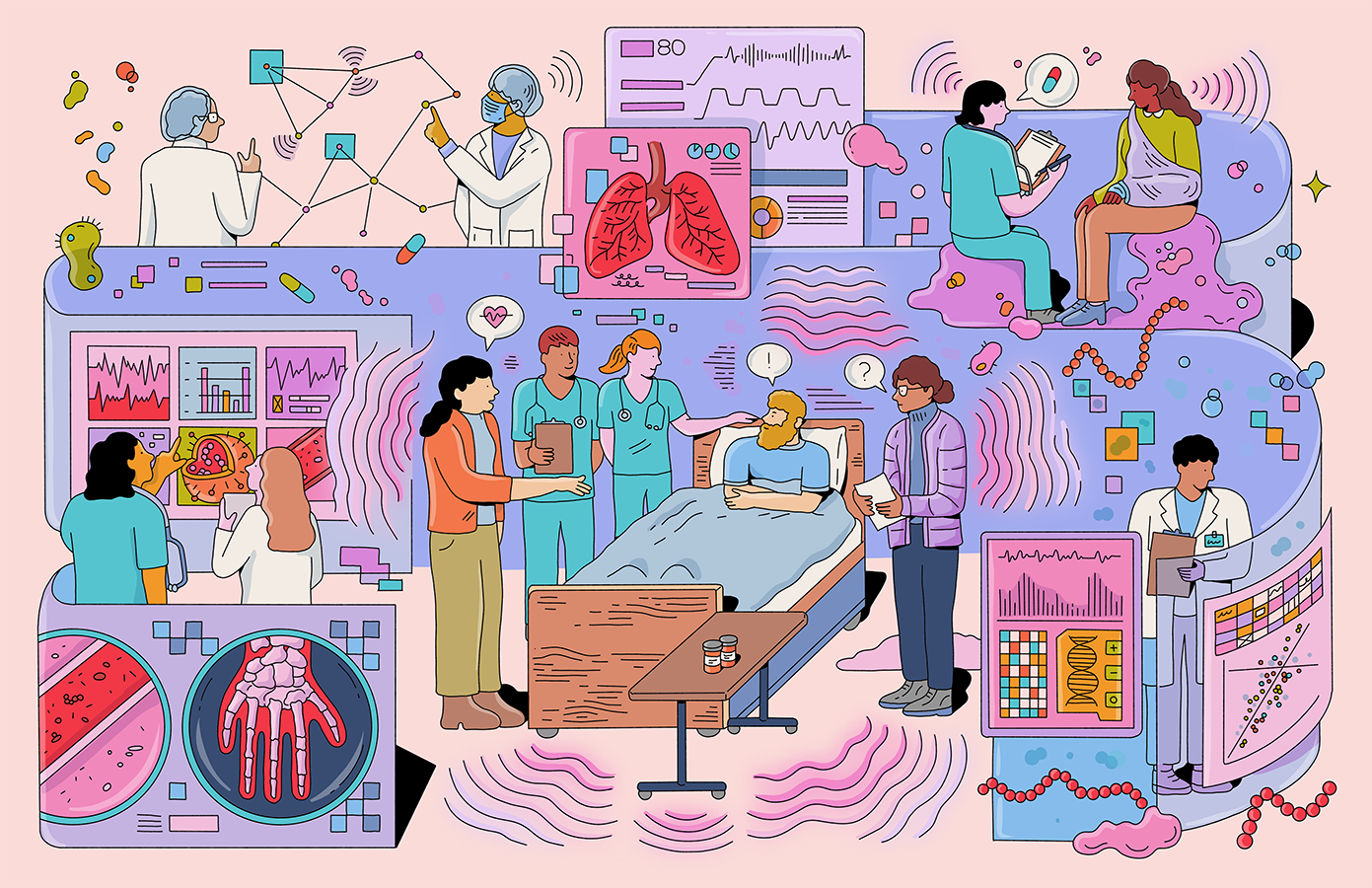
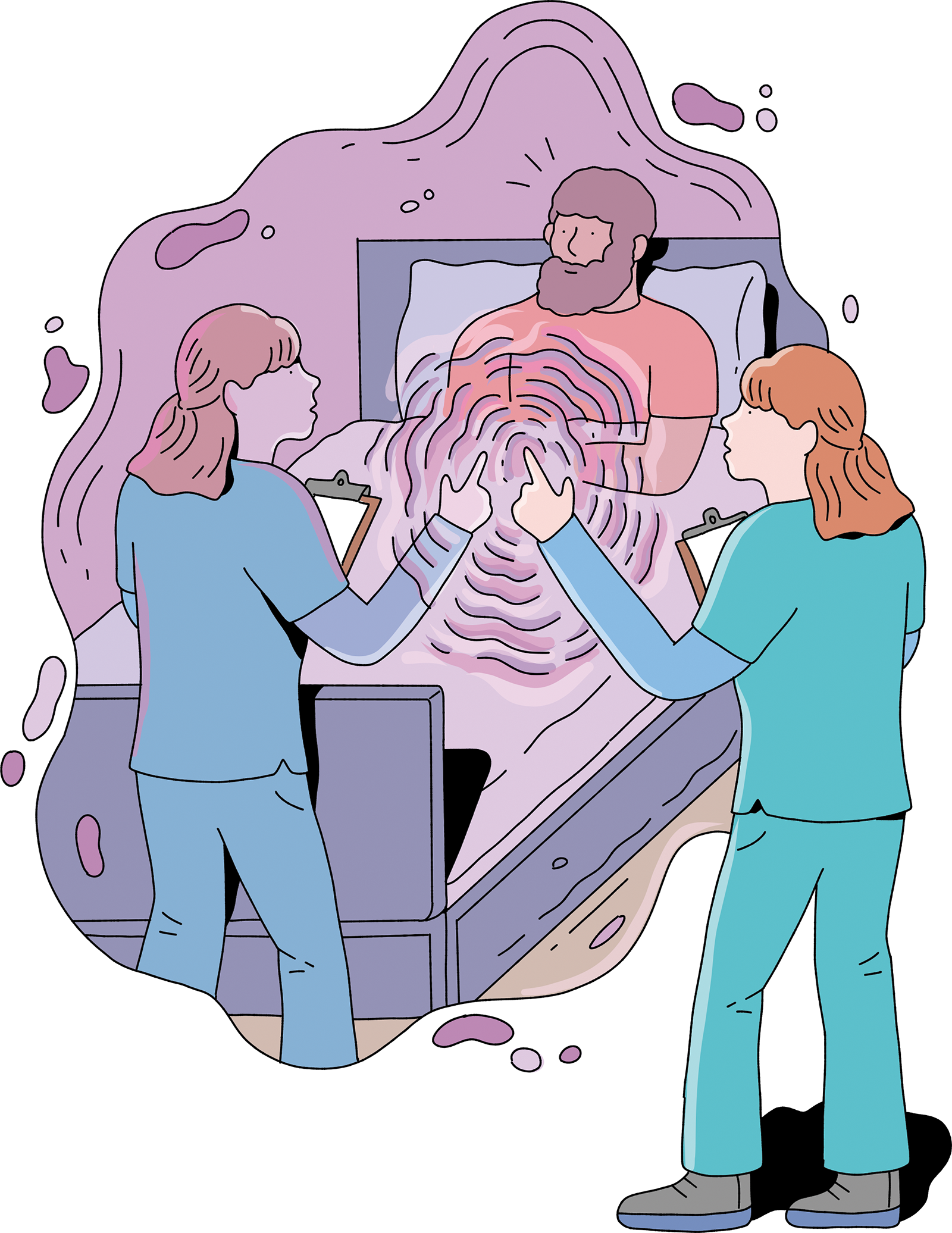
Sarah Petelinsek knocked on the door before entering the room where a patient in his early 20s sat in a chair. His sister, concerned about his drug use and mental health, had brought him there.
The situation resonated with Petelinsek, a second-year medical student tasked with determining the cause of his presenting mood symptoms and hallucinations. Her own brother struggled with substance use disorder. She imagined taking him to the Emergency Department. What would she want the doctor to say?
“It scratched at my heartstrings,” Petelinsek says, “connecting at a human level while feeling very true to my own life.”
This, however, wasn’t a real patient encounter. It was an educational simulation using a paid professional actor as the patient. Such actors are called simulated patients or SPs.
Using SPs in medical education was pioneered in 1960s southern California and, for the most part, has long been misunderstood. Over the last few years, the world of simulated patients, human or manikin, has exploded—and so too has the opportunity to create a sense of understanding around the practice.
At University of Utah Health, simulated patients have been active in teaching students since the early 2000s. When the Spencer F. & Cleone P. Eccles Health Sciences Education Building opened in 2005, it contained clinical-skills rooms with audiovisual monitoring capabilities, and the College of Nursing simulation center has been using SPs since 2010.
Over time, SP studios and simulation labs with manikins, each siloed in departments with their own rules and regulations, expanded across campus. In 2019, then Senior Vice President and U of U Health CEO Michael Good, MD, tasked Associate Vice President for Health Sciences Education Wendy Hobson-Rohrer, MD, MSPH, with bringing together all simulation activities across the health sciences.
“The actors need to be doing everything the same way so we can evaluate the students and their skills from the same baseline... we have a very specific role we need them to play.”
In part, the impetus was to plan for new space in the Spencer Fox Eccles School of Medicine building. For Hobson-Rohrer, the concept made a lot of sense because coordinating resources would provide an opportunity to improve the overall quality of simulation-based education while decreasing costs.
“We’re trying to improve the program by making it better for the actors while also enhancing faculty involvement,” says Hobson-Rohrer.
Part of this is “standardizing the actors,” she says, particularly when it comes to observed, structured clinical observations that are used for high-stakes examinations of competence.
“The actors need to be doing everything the same way so we can evaluate the students and their skills from the same baseline,” Hobson-Rohrer says. “We have a very specific role we need them to play.”
Elevating the Student Experience
Petelinsek is fascinated by simulation and the consistent feedback it provides. She recalls her first time learning from the SP simulations six weeks into medical school. In that particular scenario, Petelinsek and her classmates took an SP’s medical history as an evaluation of their communication skills. Faculty pointed out how some of the students crossed their arms, appearing uncomfortable, while others interrupted the patient; some didn’t payattention to what the patient said. These types of observations help medical students understand how their body language and behavior can come across to someone who does not know them well—and ultimately allows them to use the feedback to improve their patient interactions.
Petelinsek says that other simulations during her first year were specific patient encounters—blood pressure, medical history, a physical—and the presentation of diagnoses to attendings.
The second-year simulations empowered Petelinsek to take ownership of her interactions with patients. She learned a more disciplined focus as she went from four 25-minute SP encounters to six15-minute SP meetings back-to-back in different rooms, presented her findings to attendings, and then circled back with patients.
For Petelinsek, the cumulative effect of being watched by doctors and receiving feedback creates tremendous benefits.
“How did I make people feel? Did I do the right test? Was I a good doctor?” she says. “All those questions get answered.”
Going off Script
The U’s Graduate Program in Genetic Counseling is another program for which faculty have developed SP capabilities. Genetic counselors support people learning about their genetic health, explains Karin Dent, who directs the graduate program. Conditions they counsel on include cystic fibrosis, inheritable cancers such as breast cancer, chromosomal conditions like Down syndrome, and adult cardiovascular conditions that can present with sudden death.
In 2025, the 20-student, 21-month master’s pro-gram celebrated its 20th anniversary. In the program’s early days, administrators would ask for volunteers in the genetic community to be SPs, as hiring actors was expensive on a small budget. When Dent took over as program director in 2016, she negotiated for more money and was able to hire SPs.
SP actors are a bridge from class to clinic for first-year students, who also work with SPs in a second-year clinical rotation supplement.
Dent knows the value of having strong actors. She expects them to read scripts and prepare for the scenes. She wants SPs who can cry in difficult clinical situations, showing emotion in a convincing, natural way so faculty can see how students respond.
“SPs who are willing to embrace it, bring inhuman nature to their roles, and understand the ultimate goal is to support student development are the ones I enjoy working with most,” she says.
Ripping off the Bandage
For alumna Malia Olson, MS ’25, genetic counseling is about helping patients and families navigate genetic testing, results, and emotionally challenging decision-making.
“Sometimes it could mean an 80% chance of developing cancer or a pregnancy might not be viable, those sorts of conversations,” she says.
In the first year of the program, students participate in didactic learning along with some real-patient encounters where they conduct small parts of the appointment. “There’s a lot of nerves building up to that first patient encounter,” Olson says.
To help prepare for the patient experience, students first role-play with each other and then counsel an SP. Often, counseling the SPs helps students identify behaviors that patients could misinterpret, such as a lack of confidence being assumed as bad news.
“Having that first rip-the-Band-Aid-off moment with the SPs helps students be better equipped moving into clinic,” Olson says.
The practice also allows the opportunity for self-critique. Students can review the video of their
SP counseling session and engage with one another in class to discuss what they have observed. This practice helps students see how they could take the conversations in different directions, “which makes it feel more real,” Olson says.
“It set me up better than role plays or anything else did because the actors nailed how things go in real life shockingly well.”
In practice, Olson has encountered patients with similar issues to those she confronted with the SPs. “The SPs reflected real-life patient scenarios I had down the line,” she says. “It set me up better than role plays or anything else did because the actors nailed how things go in real life shockingly well.”
Embracing the Beauty
For both actors and students, the SP experience boils down to transforming how they experience each other’s lives.
Tiffani DiGregorio is an SP who has performed many simulations over the years. She often acts for the Utah Certificate of Palliative Education program, performing a four-day narrative akin to a play about a character progressing through a terminal illness. The students’ objective is to help her accept hospice.
“It’s about how beautiful, lovely, necessary, and gentle that process is,” DiGregorio says. “By the end of accepting this gentler way to die, it allowed me as a person, as Tiffani, to be more accepting—not of death, but of the process that it might be.”
Petelinsek wants everyone involved with the development of SP, manikin, and virtual-reality simulations at U of U Health to realize the beauty of sim: its humanity.
“It’s incredible: you get to train medical students to be better human beings, better communicators, better empathizers, and better listeners,” she says. “As an institution, we all get to help train people to be better at navigating challenging human crises. It’s beautiful.”