
The Anatomy of a Scream
Research reveals how heavy metal singers scream and squeal.
By: Sophia Friesen

DAVIDE SCIAKY/ALAMY
Deep within the halls of the imaging research center, a gaggle of voice scientists crowded around a small window wearing expressions of utter astonishment. Trading theories in hushed voices, they peered into the tiny, soundproofed room where their current study participant got ready to do what he did best. As they watched, he cupped his ears, opened his mouth, and roared: a guttural, crocodilian rattle that rolled out from the two-way mic.
To those unfamiliar with Will Ramos’s oeuvre, the sound seemed almost inhuman. But as one of the biggest names in deathcore belted out another note, he proved the human voice is an instrument that defies expectations.
“The goal is to begin to understand how a scream or a harsh vocal is different from a clean vowel, a spoken sentence, or other singing styles.”
To understand that instrument, the researchers were embarking upon a comprehensive scientific study of the harsh vocals that characterize deathcore and many other musical genres, revealing for the first time the complex internal acrobatics that produce these unique sounds.
“We’re still in the infancy of being able to understand harsh vocals,” says Amanda Stark, MS ’12, PhD, speech-language pathologist in otolaryngology in the Spencer Fox Eccles School of Medicine (SFESOM) and the lead researcher on the study. “The goal is to begin to understand how a scream or a harsh vocal is different from a clean vowel, a spoken sentence, or other singing styles.”
Sound Strategy
Collecting high-quality sound recordings was the first step in the process. Capturing each note in the absence of background noise or instrumental accompaniment let the researchers define the precise acoustic differences between, for instance, a “moose scream” and a “pterodactyl scream.”
Especially in cases like Ramos’s, whose singing style is understudied in voice science, understanding how the sounds were produced—and whether they’re causing damage—required looking at the complex internal workings of the throat.
This is where the expertise of the Voice, Airway, Swallowing Translational (VAST) research lab came to the fore. The research team looked at Ramos’s vocal cords using an internal camera and a technique called electromyography to measure the activity of his throat muscles. Finally, they captured video of his internal vocal acrobatics in real time using dynamic MRI. Together, this panel of tests—firsts for the musical genre according to Elizabeth Zharoff, producer of the YouTube channel The Charismatic Voice—provided a comprehensive view of how Ramos sings, screams, and squeals.
The results were fascinating, according to Lynn Maxfield, director of the Utah Center for Vocology and researcher on the project. Song and speech are produced in large part by vibrations of specialized tissue in the throat called the vocal folds. These are attached to cartilage-based structures that normally just open to allow us to breathe and close when we use our voices, but Ramos was torquing his to one side as he sang.
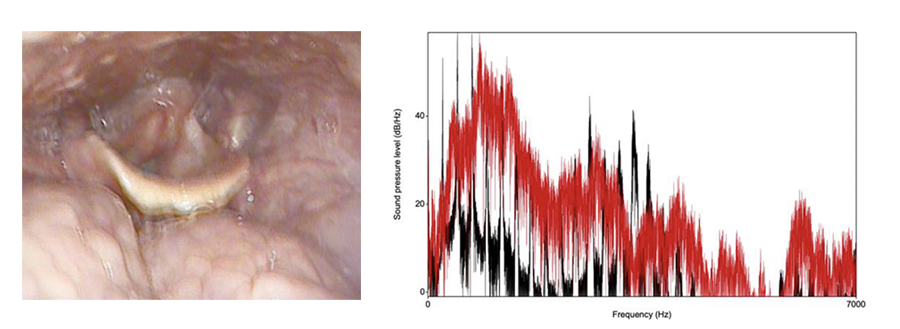
Will Ramos’s false cord scream. With the false cord scream overlayed with the clean “ah,” researchers can see the spectral structure similarities between these two sounds, suggesting that the vocal tract is in the shape they see with the “ah” vowel but the sound is being distorted by the false vocal folds.
“Watching his throat do that was—it doesn’t usually do that. The human body just doesn’t usually do that.”
“In typical voicing, we know what is creating the sound source, but with the complexity of these sounds, our conventional understanding of what constitutes ‘voice’ is being tested,” Maxfield says.
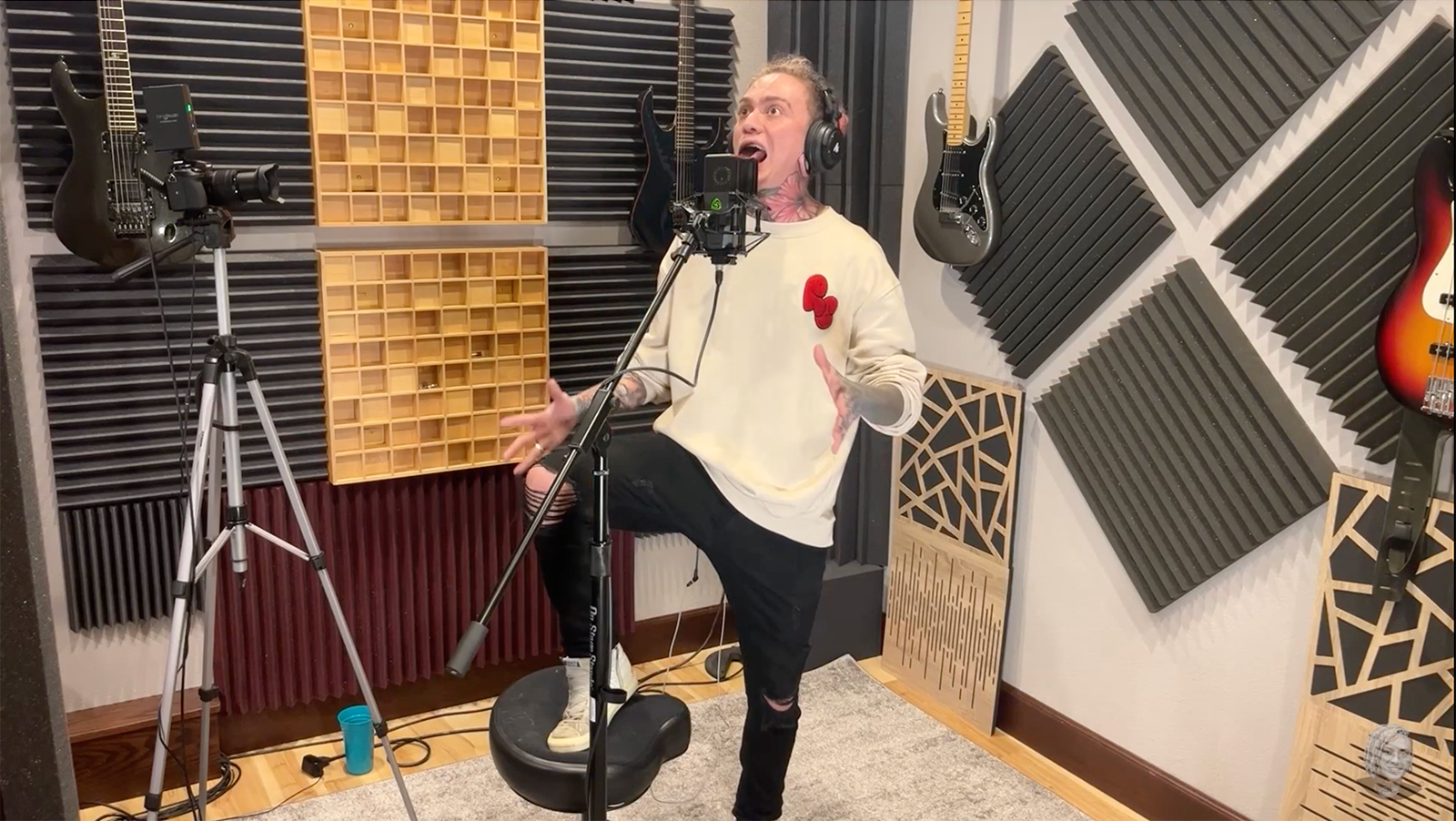
Will Ramos warms up his voice for Amanda Stark and her research team.

Elizabeth Zharoff, Will Ramos, and University of Utah Health researcher Amanda Stark pose for a photo after a day of analyzing Will’s vocal cords in the lab.
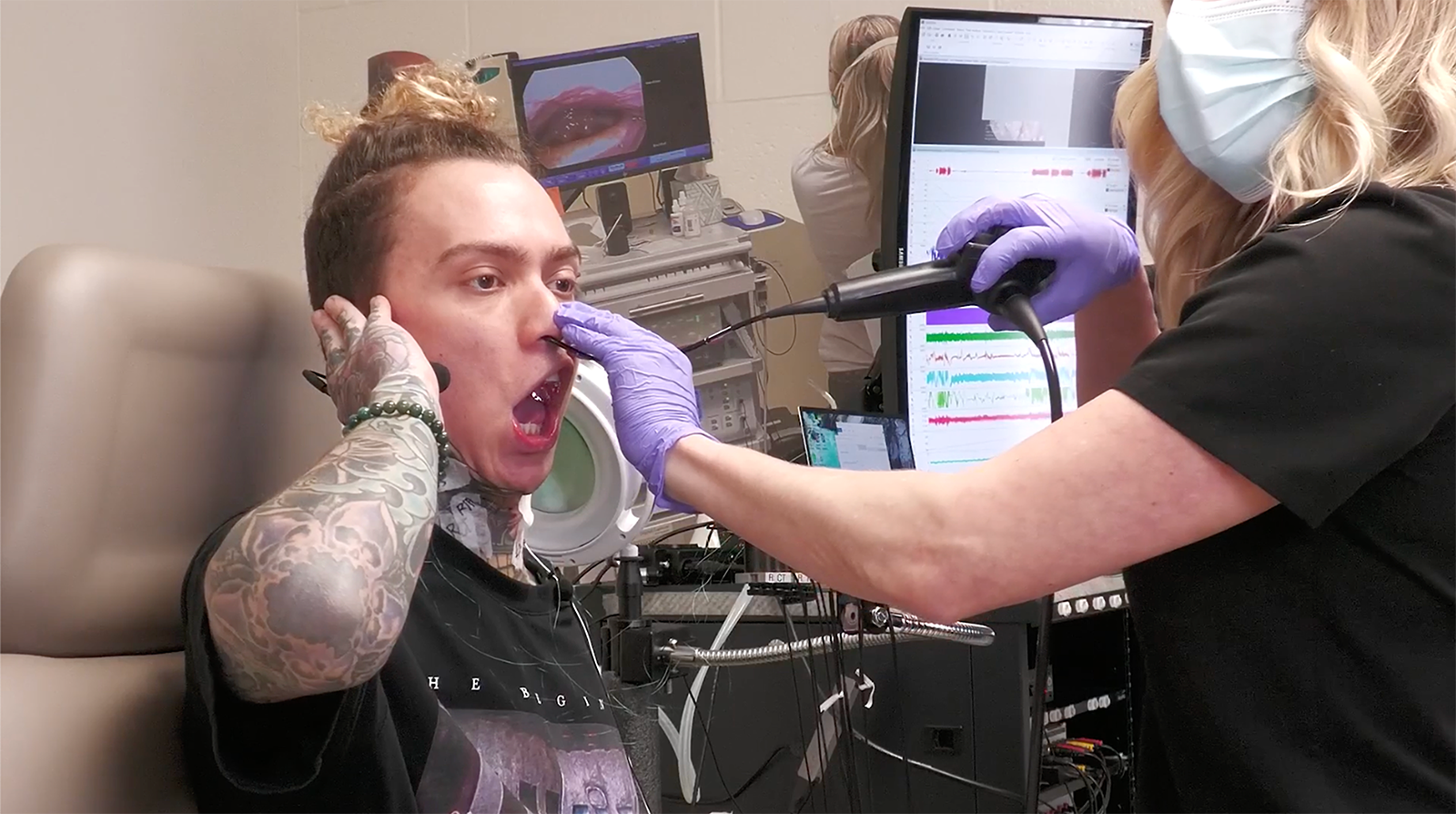
Stark prepares Ramos for the various tests his vocal cords will participate in.
Changing the Landscape
Partway through the voice recording session, after Ramos had sung dozens of acoustically distinct vocals, Stark asked him to rank his level of vocal fatigue on a scale of one to 10, with 10 being the most fatigued he’d ever felt. “Maybe a two,” Ramos replied, in a completely normal speaking voice.
The voice scientists in attendance judged Ramos’s vocal health as “fantastic,” an assessment that was later borne out by the dynamic MRI scans. By demonstrating that harsh vocals can be sung safely, the researchers hope to reduce the stigma around deathcore and related musical genres, proving that vocalists can have careers that last decades with no apparent harm.
Having a clear picture of how to produce those sounds without compromising vocal health could also help empower aspiring artists to master these styles. “How cool would it be if someone could go to Juilliard to learn harsh vocals?” muses Kirk McCune, COO of The Charismatic Voice. “It changes the landscape of how music can be created.”