
The Visionary
Randy Olson, MD ’73, reflects on a career shaped by innovation and lasting impact.
By: Maureen Harmon

Nothing that really gives you great joy and value comes easily.” —Randy Olson, MD ’73
In June 2025, distinguished Professor Emeritus Randy Olson, MD ’73, retired after 46 years of leadership, during which he served as chair of the Department of Ophthalmology and Visual Sciences and CEO of the John A. Moran Eye Center. Olson sat down with UtahMed to explore the key moments and pivotal decisions that shaped his remarkable career building the largest eye center in the Mountain West, now ranked among the Top 10 Best Hospitals for Ophthalmology by U.S. News & World Report.
Olson is a renowned cataract surgery expert who has been listed among the world’s most influential ophthalmologists. At the Moran Eye Center, he established the field of research on artificial lenses used to replace the eye’s natural one. He also created a new model for partnerships between academia, philanthropy, and investors to translate discoveries into therapies faster. We delved into the challenges Olson faced, the strategies employed, and the inauspicious start to the Moran Eye Center itself, which today boasts more than 50 specialists and 11 clinics.
YOU’VE DEDICATED OVER FOUR DECADES TO MEDICINE AND OPHTHALMOLOGY. LOOKING BACK, WHAT INITIALLY DREW YOU TO THIS FIELD?
I’m a Rocky Mountain westerner at heart. That’s a big part of who I am. I got both my undergrad and medical degree from the University of Utah. I’m an outdoor person who loves Utah, loves the mountains—backpacking, fly fishing, all of it. That love for the outdoors and that connection to the natural world have always grounded me—from my undergraduate days at the U through my career—even amidst the complexities of the medical world. Professionally, I’ve always been very goal-oriented, constantly setting new targets for myself. I was lucky enough to discover early on that I really loved what I was doing, and I loved where things were going in ophthalmology: it was a powerful motivator.
CAN YOU TELL US ABOUT THE INITIAL VISION FOR THE MORAN EYE CENTER AND THE KEY STEPS YOU TOOK TO TRANSFORM THAT VISION INTO A TANGIBLE REALITY?
I watched the process of building an eye center at Louisiana State University, and I just thought, “Could we do something like that in Utah?” I knew it would be a difficult job because, in 1979, a separate center of excellence for ophthalmology was just not something that existed. I knew it was a unique opportunity, but I also knew I would need buy-in from people who weren’t afraid to take that risk. And, luckily, I had many people early on who were prepared to buy into it.
WHAT WERE SOME OF THE SIGNIFICANT OBSTACLES YOU ENCOUNTERED IN ESTABLISHING AND GROWING THE MORAN EYE CENTER? HOW DID YOU OVERCOME THESE HURDLES, AND WHAT LESSONS DID YOU LEARN IN THE PROCESS?
There were certainly challenges, no doubt about it. I started at the U as a one-person Division of Ophthalmology. Gaining official department status required strategic maneuvering and a bit of political savvy, but we knew it was critical to become a department in order to truly flourish and make the impact we envisioned. I got myself on the executive committee, and that ultimately allowed us to push through. I knew I needed to be smart to make sure I could support my colleagues while fighting for a good cause.
Securing adequate funding was another constant concern. I remember telling the dean and vice president that I knew they didn’t have money to support this and asked to have their blessing to raise the money. So I took some courses, and we did it thanks to many generous donors who shared my vision for what we could build together. In the end, we didn’t ask for any public funding. That step was absolutely critical. It was a constant balancing act between ambitious goals and limited resources, but it forced us to be creative, resourceful, and deeply committed to our mission.
WHAT LESSONS HAVE YOU LEARNED ALONG THE WAY THAT YOU BELIEVE COULD BENEFIT THE NEXT GENERATION OF MEDICAL PROFESSIONALS?
I would say that nothing that really gives you great joy and value comes easily. So, if it’s really easy, you’re probably just scratching the surface. In the modern world, everything is instant, but medicine can be a slow-moving process. Have the audacity to dream big, but never lose sight of the practical realities and the importance of hard work and perseverance. Medicine is not just about intellectual knowledge. It’s also about empathy, compassion, and a genuine desire to help others.
YOU’VE WITNESSED FIRSTHAND THE RAPID EVOLUTION OF MEDICINE, PARTICULARLY IN AREAS LIKE RESEARCH AND TECHNOLOGY. WHAT ARE SOME OF THE MOST EXCITING AND PROMISING DEVELOPMENTS YOU SEE ON THE HORIZON, AND HOW DO YOU BELIEVE THESE ADVANCEMENTS WILL TRANSFORM THE FUTURE OF HEALTH CARE?
The United States has been the number-one resource for coming up with new and innovative ways of dealing with diseases and processes in the world. Medicine is always changing. Right now, I’m most excited about a gene therapy for age-related macular degeneration developed at Moran’s Sharon Eccles Steele Center for Translational Medicine. I think it will be a real game changer for millions of people worldwide.
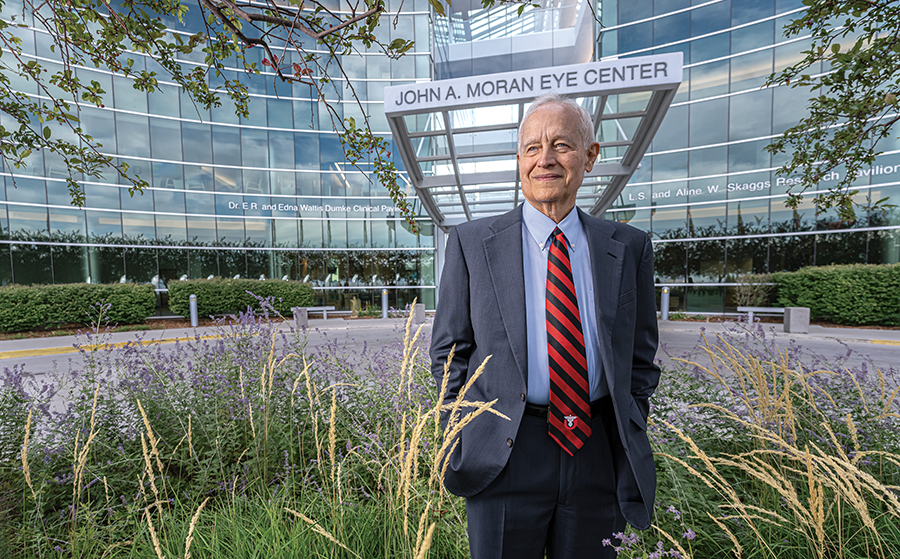
Randy Olson, MD ’73, retired in 2025 after over four decades of building and leading the largest eye center in the Mountain West.
AS YOU REFLECT ON YOUR CAREER AND THE IMPACT YOU’VE MADE, WHAT DO YOU HOPE YOUR LEGACY WILL BE IN THE FIELD OF MEDICINE? WHAT LASTING CONTRIBUTIONS DO YOU ASPIRE TO LEAVE BEHIND FOR FUTURE GENERATIONS?
Legacy isn’t about me; it’s about my colleagues and my friends and what they have given me. If I didn’t have a few core people who believed in my idea and in me, I would just be another dissatisfied dreamer who’s floating through life, wondering where all the time went. That said, I couldn’t be prouder of the work we have done at the Moran Eye Center to ensure no one facing a blinding condition, eye disease, or visual impairment should be without hope, understanding, and treatment. I think about the next chapter with confidence in my successor, Jeff Pettey, MD, MBA ’20, a longtime Moran physician leader who is ready for the challenge.